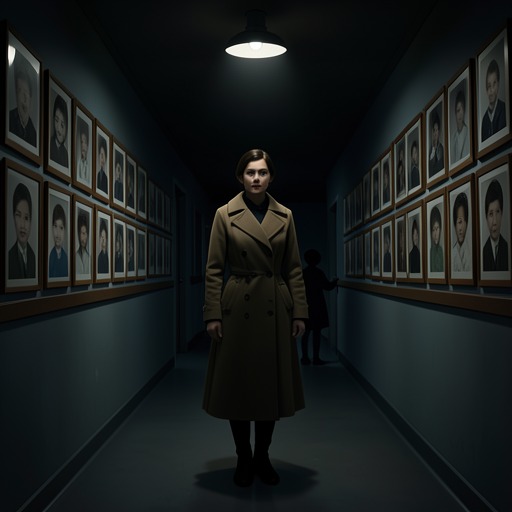
“Falling off the edge of the world” imagery
Down Cemetery RoadThe “Falling off the edge of the world” imagery gives a recurring shape to Sarah Trafford’s loss of orientation: experience becomes discontinuous, the familiar world seems remote, and even her own memories become difficult to trust. The image first returns amid the police investigation into Joe Silvermann’s death, when Sarah is overwhelmed by questioning; it recurs through the drug regimen that keeps her calm but blurs her sense of reality. Later, as she follows Michael Downey, the metaphor changes direction. The world she had fallen from is not restored, but Sarah begins to act within the uncertainty rather than merely endure it.
The Image and Its First Recurrence
The image is not a description of a new physical fall. It names a collapse in Sarah’s ability to remain securely oriented in ordinary life. Before the police station, a gloved policeman holds up a polythene bag of white powder, and Sarah feels the lights cartwheeling in her head once more. The visual instability makes the moment register in her body before she can understand its consequences. The image then expands beyond the instant: “That day, too, she fell off the edge of the world.” The word “too” makes the experience recurrent, linking this crisis to a previous rupture rather than presenting it as an isolated shock.
At the station, the loss of footing becomes temporal and social as well as perceptual. Sarah is questioned for hours about drugs and Joe Silvermann, until she becomes convinced that whatever she is hiding will eventually emerge and gives the police information about Dinah Singleton, the man in the car park, and the bomb at the nearby house. The interrogation’s repetition narrows her choices: each disclosure is followed by another return to drugs or Joe, while the officers’ questions about Lizbeth Moss and Ecstasy expose how little control Sarah has over the direction of the inquiry. Her own account is pulled into a process she cannot make coherent.
By eight in the evening, Sarah no longer knows where she is or how to respond. The hours in custody feel detached from the life that preceded them. Her recollection of a girl on a towpath is uncertain enough that she wonders whether there had ever been a real Dinah; she also remembers Michael Downey and considers whether he might have killed Joe Silvermann. These are not settled conclusions but thoughts formed inside disorientation. The world has not simply become threatening: its people and events have become difficult to place with confidence.
The Station and the Failure of Ordinary Bearings
Sarah’s tears provide a small, tactical form of control within this larger helplessness. She uses them as a mask, hoping the officers will leave her alone, and they work only “up to a point.” An Asian policewoman calls her Sally and repeatedly asks whether she needs cocaine or is beginning to suffer withdrawal. Sarah cries again to stop the questions. The mistaken name and drug assumptions make her feel less legible to the people holding her, even as she tries to manage what they see.
Mark Trafford arrives with Simon Smith, whose black briefcase and loud talk of lawsuits make him seem at ease in the legal confrontation; Mark, by contrast, is livid. Their arrival interrupts Sarah’s isolation, but does not immediately restore her independence. Simon takes charge of the practical problem, and Sarah later signs a statement saying the cocaine in her possession came from Joe Silvermann, that she bought drugs from him twice, and that she met him in a pub. Simon assures her that this cooperation will effectively end official interest in her. The statement offers an exit from immediate pressure, but it also records Sarah’s participation in an account shaped by the investigation rather than by her own recovery of certainty.
The narrative’s fragmented returns to thought reinforce the image. Sarah’s mind moves from the drugs and Joe to Dinah, the bomb, and the man in the car park; memory does not arrive as a stable sequence that could put the world back in order. Even incidental details, such as Simon’s use of the word “totty,” jolt loose at inappropriate times. The dislocation is therefore not confined to the police station. It follows Sarah into the aftermath, where ordinary recollection can be interrupted by fragments whose relevance is uncertain.
Medication, Memory, and a Blurred World
After the questioning, medication gives Sarah a routine that promises steadiness while keeping the earlier crisis present. The refrain “Blue pills at night to ease Sarah’s fright. Red pills on waking to quiet her shaking” divides the day into fear and its attempted suppression. The pills work, but their importance gradually shifts: they become reminders of the world waiting for Sarah when she stops taking them, “the world she’d fallen off once already.” Calm and dependence thus occupy the same image. The treatment eases distress while making Sarah anticipate the return of the experience it is meant to quiet.
As the days pass, the world grows fuzzy at the edges. Sarah tells herself this may be the aftereffects of shock rather than the effect of being tranquilized, and the calm the pills provide makes that explanation easier to accept. A surviving skeptical voice warns her that beliefs encouraged by the medication cannot be trusted, but it appears only intermittently, in the early hours or as she wakes from an afternoon nap. Mostly she ignores it and gets by. The account does not present recovery as a clear passage from illness to health; Sarah’s limited capacity to question her own calm coexists with her need for it.
The medication also opens a path into older memories. Sarah’s nights become dream-free and long, while waking brings her back to her student days and the aftermath of her accident. The first hours remain inaccessible, but the period in hospital feels unusually fresh, as if the present regime had opened a door into an earlier part of her life. These recollections can feel like the first days of her life. The image of falling therefore connects a present crisis to an earlier break in Sarah’s experience, while the narrative preserves a gap around what she cannot remember. The past returns, but not as a complete explanation that would resolve the present.
From Disorientation to Deliberate Action
The later recurrence of the image comes as Sarah follows Michael Downey through the shadows. Her legs have gone weeks without exercise; as she hurries to match his pace, her blood pounds and her skin tingles. These bodily sensations register a return to activity before she has settled what that activity means. Sarah recognizes the danger of following a man she has seen kill without hesitation, and she resists the idea of relying on him for instruction. Mark’s betrayal is also coming into focus—not only the kiss on the railway platform, but the recent pattern of a doctor brought in to give her pills and sex treated as therapy. The scene places physical reawakening beside a sharper recognition of how others have managed her.
Sarah admits that her pursuit of Dinah Singleton began less from a settled attachment than from a desire to do something, anything, against terrible boredom. Gerard Inchon had named that impulse Bored Housewife Syndrome. In retrospect, Sarah says she could have followed a treasure map with just as much concern. This recognition complicates the search without erasing its consequences: her initial motive may have been shallow, but events have become real, and Dinah is a child caught in them without understanding the game. Sarah’s stated reason for continuing is now to finish what she began and learn what Downey knows, not to obtain revenge or reconciliation.
The passage contrasts the damaged present with the former domestic routine, whose long days and supper decisions acquire a prelapsarian glow only after Sarah has lost access to them. Looking back offers no way to undo the damage; there is no cosmic dentist to repair what has been broken. Sarah instead chooses between going to earth and starting again at the beginning, refusing to give up on finding Dinah. When she asks what they are looking for, Downey answers that they need a hotel. The ordinary, practical answer does not resolve the larger danger, but it places Sarah inside a next step she has chosen to pursue. The image’s final significance lies in that change: falling describes her repeated estrangement from the world, while her movement with Downey marks an incomplete, wary return to agency.